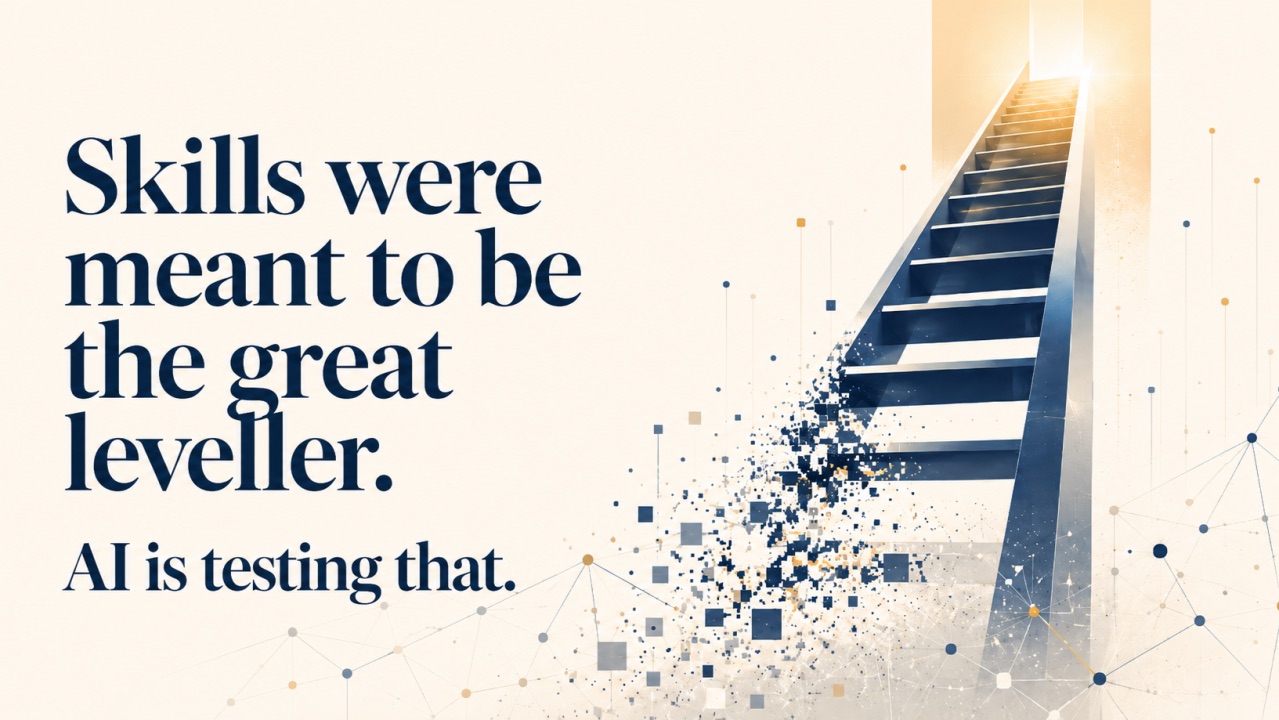
The most valuable skill in the age of AI is the one you can't study for.
That should trouble anyone who believed skills were the great leveller.
For decades we sold a simple promise, mostly to the young and to those who started with the least. Learn the skill and the door opens. It was the engine of social mobility. It was also a quiet way of assigning blame: if you didn't make it, the fault was yours.
That promise is now running into the evidence.
Anthropic recently looked at around 400,000 sessions of people using its AI coding tools. The finding that matters here is not about coding. The people who got the most from the tools were not the strongest programmers. They were the ones who understood the underlying problem best. Once the machine handles the execution, raw technical skill, the thing a generation was told to go and acquire, starts to come apart from results. What gains value is judgement. Knowing what "correct" actually looks like.
And this kind of expertise is oddly specific. A senior engineer asking their first question about an unfamiliar language is, for a moment, a novice. An accountant who has never written a line of code but knows exactly which rules a reconciliation must follow is an expert, because they can see at a glance when the answer is wrong. The developer Aaron Brethorst, writing independently of that study, put it cleanly: the binding constraint has moved from "can you build it" to "can you tell whether it's right."
On the face of it, this is good news, and genuinely levelling. If what counts is understanding a problem rather than holding a technical qualification, then the nurse, the warehouse manager and the small-business owner can all build useful things without paying for an expensive credential first. Expertise is everywhere. Almost everyone is an expert at something.
But the levelling promise has a hidden dependency.
Domain expertise is the hardest thing to fast-track. You can study for a certificate. You cannot study your way to ten years of knowing how a claims department really behaves, what breaks, and what the official process quietly ignores. You earn that by spending time in the role.
Which brings us to the second piece of evidence.
A Stanford team led by Erik Brynjolfsson found that in the occupations most exposed to AI, employment for 22 to 25 year olds has fallen by around 16 per cent since generative AI arrived, even after controlling for company-level shocks. Employment for older workers in those same roles held up or grew. The early jobs people used to climb through to build expertise are among the first under pressure.
So the trap closes from both sides. The thing that now matters most is experience. The entry-level work that used to create experience is the work being automated soonest. The skill that is appreciating is the one you can only acquire by doing the jobs that are disappearing.
If that holds, skills stop being a leveller and quietly become the opposite. The new currency is tenure and access. Who let you into the room, and how long you have been there. Those are precisely the advantages the skills promise was supposed to cancel out. We would be re-entrenching privilege while congratulating ourselves on democratising it.
No wonder younger workers are now the most pessimistic group of all about their prospects, a reversal of how this usually runs. When people at the start of their careers regard AI with suspicion rather than enthusiasm, a fair part of the reason is sitting in that data.
The evidence for all this is still early. Two studies and a practitioner's field notes are not settled science, and anyone selling you certainty about AI and the labour market is selling something. But the mechanism is coherent and the early direction is consistent. That is enough to take it seriously.
It also means none of this is fixed. This is not a prophecy. It is a fork.
The same Stanford research found that the outcome turns on a choice. Where firms used AI to automate the junior role, entry-level hiring fell. Where they used it to augment junior workers, helping them do more and learn faster, employment held up. Same technology. Different decision.
The answer is not to protect junior busywork. Plenty of it deserves to go. The answer is to redesign junior work so that people still build judgement while the machine takes the grind.
AI really could be the leveller we keep calling it. It could let millions of people apply expertise they already have, and it could shorten the time it takes a newcomer to become genuinely good. But none of that happens on its own. Left to its defaults, the technology drifts towards deleting the cheapest roles, which happen to be the ones where people learn the job.
The mechanisms that make this a net gain will not appear by accident. Using AI to develop people rather than replace them at the bottom, and building the new routes in before we close the old ones, have to be designed. The time to do it is now, while the patterns are still soft.
We told a generation that effort would be enough. It was never quite true. The chance now is to make it so, for the next one.
Sources
- Anthropic, "Agentic coding and persistent returns to expertise": https://www.anthropic.com/research/claude-code-expertise
- Aaron Brethorst, "Domain Expertise Has Always Been the Real Moat": https://www.brethorsting.com/blog/2026/05/domain-expertise-has-always-been-the-real-moat/
- Brynjolfsson, Chandar & Chen, "Canaries in the Coal Mine? Six Facts about the Recent Employment Effects of Artificial Intelligence" (Stanford Digital Economy Lab): https://digitaleconomy.stanford.edu/publications/canaries-in-the-coal-mine/
- Yale Insights, "The Real Job Destruction from AI Is Hitting Before Careers Can Start": https://insights.som.yale.edu/insights/the-real-job-destruction-from-ai-is-hitting-before-careers-can-start